
When child support payments stop coming, the financial and emotional stress can be overwhelming. In Houston and Harris County, thousands of parents face this challenge every month, struggling to provide for their children while navigating Texas's complex enforcement system. Every child in Texas has a legal right to financial support from both parents, making enforcement a critical issue for families. Delinquent child support payments are reported to credit reporting agencies, negatively affecting the obligor's credit rating. Understanding your options for child support enforcement Houston requires knowing both the resources available through state agencies and when private legal representation becomes essential. This article explains the legal procedures, enforcement methods, and remedies available to parents seeking child support enforcement in Houston.
The Texas Family Code provides multiple enforcement mechanisms, from wage garnishment to contempt of court proceedings, but the path you choose can dramatically impact how quickly you see results. In Houston, child support enforcement is primarily handled by the Office of the Attorney General (OAG) Child Support Division, which oversees the majority of cases. A court can enforce child support orders by garnishing wages, imposing property liens, or suspending a driver's or professional license. Whether you're a custodial parent seeking to collect overdue support or a noncustodial parent facing enforcement actions, this comprehensive guide explains every aspect of the child support enforcement process in Houston, Harris County, and throughout Texas.
Need help with child support enforcement in Houston? Contact The Law Office Of Jimoh PC at (713) 271-8484 or message us online for a confidential consultation.

Houston Child Support Enforcement Options
Houston parents have several pathways to enforce child support orders, each with distinct advantages and timelines. The primary options include working with the Texas Office of the Attorney General, filing a suit for private enforcement actions through Harris County family courts, or utilizing the specialized IV-D child support courts located at the Family Law Center. The Office of the Attorney General (OAG) is the official child support enforcement agency for the State of Texas, providing a centralized system for managing cases. The OAG can also publicly identify individuals who are delinquent on child support payments, adding another layer of accountability.
The Office of the Attorney General operates a statewide child support enforcement program that handles the majority of cases in Texas. The OAG can assist parents with enforcement of child support orders, but it does not represent individual parents and its assistance is limited to child support enforcement, not other aspects of court orders. However, this system prioritizes volume over individualized attention, often resulting in delayed responses to urgent situations. Parents typically wait months for OAG action while children go without necessary financial resources. The OAG can request the suspension of a driver's license if a person is more than three months overdue on child support, which can serve as a strong incentive for compliance.
Private attorney representation offers a faster, more strategic approach to enforcement. When you retain The Law Office Of Jimoh PC, a suit for enforcement actions can be filed within days rather than months, and court hearings can be scheduled more rapidly than through the OAG system. Private attorneys can also pursue multiple enforcement tools simultaneously and provide personalized legal strategy tailored to your specific circumstances. Failure to pay child support can lead to criminal prosecution as a Class B misdemeanor, resulting in a fine of up to $500 and potential jail time of up to six months. Additionally, willful nonpayment of child support can be prosecuted as a criminal offense under federal law, specifically the Deadbeat Parents Punishment Act, making timely legal action even more critical.
Immediate steps parents can take when child support payments are missed include documenting the nonpayment, gathering financial information about the obligor, and contacting either the OAG or a private attorney. The key is acting quickly before arrears accumulate and become more difficult to collect. Court orders for child support can be enforced through various legal mechanisms, including wage withholding, contempt proceedings, and other enforcement procedures, especially when a parent is not paying child support as ordered.
If your child's other parent has stopped paying court ordered child support in Houston or anywhere in Harris County, contact The Law Office Of Jimoh PC at (713) 271-8484 or message us online immediately to discuss fast, aggressive enforcement options that protect your family's financial security.
Timeline expectations vary significantly between enforcement methods. OAG cases typically take 3-6 months before meaningful action occurs, while private enforcement actions can result in court hearings within 30-60 days. Emergency situations involving substantial arrears or urgent financial need can be expedited through proper legal representation.
Texas Office of the Attorney General Child Support Services
The Texas Office of the Attorney General operates a comprehensive child support enforcement program designed to establish paternity, locate non-paying parents, and enforce child support obligations across the state. In Houston, this program works through specialized IV-D child support courts and coordinates with Harris County agencies to pursue delinquent obligors. The court can issue a money judgment for back medical and dental support, which is enforceable like monthly child support payments.
The OAG's enforcement toolkit includes wage withholding through Income Withholding Orders served directly on employers, federal tax refund intercepts that can capture substantial payments during tax season, and professional license suspensions that can effectively motivate compliance from licensed professionals. Wage withholding for child support is one of the few reasons in Texas that wages can be garnished or withheld. Additional administrative tools include driver's license suspension, hunting and fishing license revocation, and credit bureau reporting of unpaid child support debt. The court can also order the garnishment of a nonpaying parent's wages for child support enforcement, ensuring consistent payments. Only those who are eligible may be subject to certain enforcement actions, such as license suspension or other remedies, depending on their compliance with child support obligations.
However, the OAG system has significant limitations that parents must understand. The agency explicitly states it does not represent individual parents the way a private attorney does—instead, it represents the state's interest in child support collection and can only assist with enforcing child support orders. The OAG cannot assist with enforcing property division provisions or other legal matters outside of child support enforcement. If you need help with property division or broader legal issues, you may need to pursue private legal action. This means parents cannot expect personalized legal advice, strategic planning, or aggressive advocacy for their specific situation. The OAG's focus on high-volume case processing often results in cookie-cutter approaches that may not address complex family dynamics or unique financial circumstances.
Cases involving multiple children from different relationships, self-employed obligors with irregular income, or interstate enforcement issues frequently exceed the OAG's standard procedures. When obligors hide assets, operate cash businesses, or live in other states, the administrative tools available to the OAG may prove insufficient, requiring more sophisticated legal strategies.
Average processing times in Harris County reflect the OAG's caseload challenges. New enforcement requests typically take 60-90 days for initial review, and meaningful enforcement action may not occur for 4-6 months. During this time, children go without support while arrears accumulate with interest under Texas law. Interest accrues on unpaid child support at a rate of six percent simple interest per year from the date the support is delinquent until it is paid or confirmed as a money judgment.
Private Child Support Enforcement in Houston
Filing enforcement actions independently with a private attorney offers several compelling advantages over relying solely on the OAG system. Private representation enables immediate action, personalized strategy, and access to enforcement tools that may not be available through administrative channels.
Faster resolution times represent perhaps the most significant advantage of private enforcement. While OAG cases languish in bureaucratic processing, private attorneys can file enforcement motions within days of being retained and often secure court hearings within 30-45 days. This speed can be critical when families face immediate financial hardship or when obligors are attempting to hide assets or leave the state.
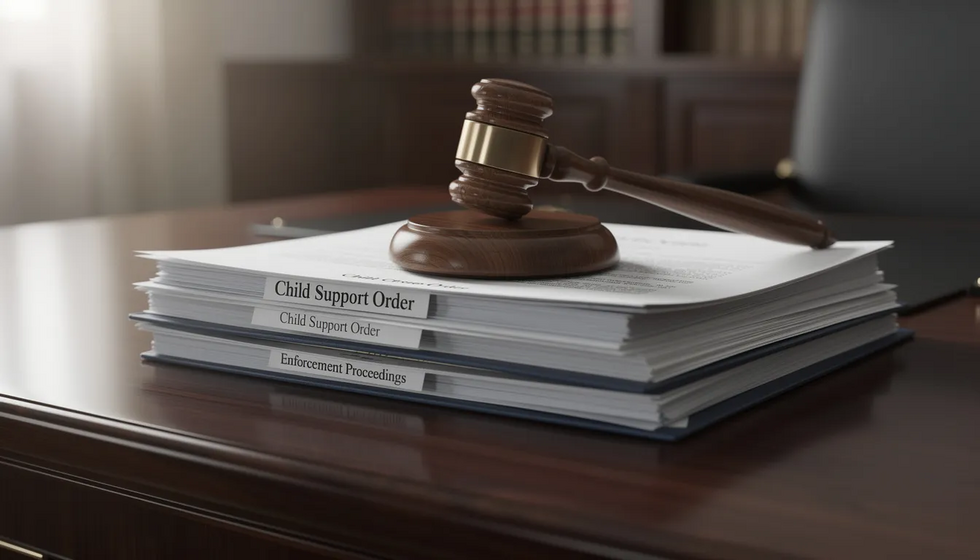
Additional relief options available through private enforcement include expedited discovery to locate hidden assets, temporary restraining orders to prevent asset dissipation, and more aggressive contempt proceedings that can result in immediate incarceration. Private attorneys can also coordinate multiple enforcement strategies simultaneously, such as pursuing both wage garnishment and property liens while preparing contempt charges.
Property liens represent a powerful enforcement tool that can secure payment from obligors who own real estate, vehicles, or other valuable assets. Texas law allows liens to be placed on non-homestead property, and these liens must be satisfied before the property can be sold or refinanced. Asset levies can reach bank accounts, investment accounts, and business assets when properly executed through court orders.
Contempt of court proceedings filed by private attorneys often carry more weight than OAG actions because they involve direct representation and can be tailored to the specific facts of each case. A judge has the discretion to determine the appropriate sanctions, including incarceration or fines, and may impose more substantial penalties when families have invested in private representation, viewing this as evidence of the seriousness of the nonpayment. The judge can also suspend a nonpaying parent's professional license as a penalty for non-payment of child support, adding another layer of enforcement. In some cases, people ask, "can child support be forgiven or modified?" Only a judge can decide whether child support obligations can be changed or reduced, and generally, past-due child support cannot be forgiven except in very limited circumstances.
If you need immediate action on unpaid child support, message online for a free consultation about your child support case. Our Houston child support attorneys can review your situation and explain how private enforcement can accelerate collection of the money your family needs.
Court Remedies and Penalties
Texas courts have broad authority to impose substantial penalties for willful nonpayment of child support. Understanding these remedies helps both obligees seeking enforcement and obligors facing potential sanctions understand the serious consequences of noncompliance with support orders.
Contempt of court proceedings represent the most immediate threat to non-paying parents. When a court finds that an obligor willfully failed to pay court-ordered support, judges can impose civil or criminal contempt sanctions. Civil contempt typically involves coercive incarceration - jail time that continues until the obligor pays a specified “purge” amount to secure release. Criminal contempt involves punitive jail sentences that cannot be avoided through payment.
Community supervision, also known as probation, can extend for up to 10 years under Texas Family Code provisions. This supervised release typically includes conditions such as regular reporting to probation officers, mandatory payment of current support plus arrears, job search requirements for unemployed obligors, and automatic wage withholding once employment is obtained. Violation of probation terms can result in immediate incarceration. If a nonpaying parent is sentenced to community supervision and fails to comply, a motion to revoke can be filed, leading to further legal consequences.
Asset seizure and property liens provide courts with powerful tools to secure payment from obligors with property or financial resources. Texas law protects homestead property from child support liens, but non-homestead real estate, vehicles, business assets, bank accounts, and personal property can be subject to seizure and sale to satisfy child support arrears.
Criminal penalties under Texas law can apply to chronic non-payment situations. While child support enforcement is primarily a civil matter, intentional or knowing nonpayment can be prosecuted as a state jail felony when arrears exceed $10,000 or remain unpaid for more than two years. Federal criminal charges may apply when obligors cross state lines to avoid payment or when nonpayment exceeds one year and $5,000.
Creating a Child Support Order
Establishing a child support order is a crucial first step in ensuring that a child's financial needs are met following a separation or divorce. In Texas, a child support order is a court-ordered directive that clearly outlines each parent's financial responsibilities, providing a legal framework to guarantee the child receives consistent support. The process is designed to protect the child's best interests and create a stable environment, regardless of changes in the parents' relationship.
Under the Texas Family Code, child support payments are typically calculated based on the non-custodial parent's net income, with a set percentage allocated depending on the number of children involved—ranging from 20% for one child up to 40% for five or more children. However, the court may consider additional factors, such as the income of both parents, the specific needs of the child, and any extraordinary expenses, to ensure the support order is fair and appropriate.
To initiate a child support order in Houston, either parent—or the Office of the Attorney General—can file a petition with the court. This process is often managed with the assistance of a Houston child support lawyer or experienced Houston child support attorneys, who can help navigate the legal requirements and advocate for a fair outcome. During the proceedings, the court will review financial documents, employment records, and any relevant information about the child's needs before issuing a court-ordered child support amount.
Once a support order is established, it is essential for the non-custodial parent to make timely child support payments as directed by the court. Failure to comply with court-ordered child support obligations can trigger enforcement actions such as wage garnishment, suspending licenses, or even jail time for contempt of court. The court may also require the non-paying parent to cover reasonable attorney's fees and court costs incurred during enforcement, further emphasizing the importance of compliance.
For parents with variable income or those who are self-employed, the court may take additional steps to accurately assess financial resources and ensure the child support amount reflects the parent's true earning capacity. In these situations, consulting a knowledgeable child support attorney is especially important to ensure the support order is both fair and enforceable.
If a parent experiences a significant change in circumstances—such as job loss or a substantial change in income—it is critical to seek legal advice and request a modification of the support order through the court, rather than simply stopping payments. Ignoring court-ordered obligations can result in severe penalties, including damage to credit, property liens, and even incarceration.
Ultimately, the creation of a child support order is about more than just legal compliance—it is about providing for the child's well-being and future. By working with a Houston child support lawyer and following the proper legal process, parents can ensure their child's needs are met and avoid the serious consequences of nonpayment under Texas law. If you need assistance with filing, calculating, or enforcing a child support order, consult with a qualified attorney to protect your rights and your child's best interests.
Houston Child Support Calculation and Modification
Texas Family Code guidelines establish standardized percentages for child support calculated based on the obligor's net monthly income. The statutory guidelines require 20% for one child, 25% for two children, 30% for three children, 35% for four children, and 40% for five or more children. There is a statutory presumption of a cap on net resources of $6,000 per month for child support calculations. The guidelines for child support are presumed to be reasonable, but the court can adjust them if they are found to be unjust or inappropriate. These percentages apply to the first $9,200 of monthly net income, with higher amounts subject to discretionary calculations. The amount of child support is based on the noncustodial parent's income and the number of minor children that parent has. If there are additional children in the obligor's household, support obligations may be adjusted to account for these additional children, which can also affect the outcome of any requested modifications.
Harris County judges interpret substantial change requirements consistently with statewide standards, but local practices may influence how modifications are processed and approved. A substantial change typically involves alterations in income of at least 20% or changes in circumstances that would result in a monthly support difference of at least $100 or 20% of the current order, whichever is greater. Texas allows child support rates to be modified when a shift in income or a new child would change the monthly amount required under the state formula by at least 20 percent or $100.
Documentation needed for income changes includes recent pay stubs covering at least three months, tax returns for the previous two years, employment verification letters, and records of any unemployment benefits or other income sources. Self-employed parents must provide profit and loss statements, bank records, and detailed business expense documentation. When requesting custody modifications, parents need evidence of changed circumstances affecting the children's best interests.

Special circumstances affecting support calculations in the Houston area include high-cost childcare in urban areas, private school expenses when agreed upon by parents, and extraordinary medical needs. Harris County's higher cost of living compared to rural Texas areas may influence judicial discretion in calculating support above guideline amounts, particularly for high-income obligors.
If your income has changed significantly or your co parent is not paying the correct amount of child support, contact The Law Office Of Jimoh PC at (713) 271-8484 or message us online for modification assistance that protects your rights and ensures appropriate financial support for your children.
Modification procedures require filing specific pleadings that demonstrate substantial changes in circumstances since the last order. Courts cannot modify support retroactively to dates before the modification petition was filed, making prompt action essential when circumstances change. A review for modification can occur three years after the entry of the original order or when a job loss, promotion or some other event occurs. The modification process typically takes 60-90 days in Harris County courts, depending on whether the other parent contests the requested changes.
Interstate Child Support Enforcement
The Uniform Interstate Family Support Act (UIFSA) provides the legal framework for enforcing child support orders across state lines. Houston parents dealing with obligors who live in other states must navigate federal regulations and coordinate between multiple state agencies to achieve effective enforcement.
UIFSA applications filed in Houston can establish jurisdiction over out-of-state obligors and enable enforcement of Texas child support orders nationwide. The process involves registering the Texas order in the obligor's home state and working with that state's child support enforcement agency to pursue local remedies such as wage withholding and license suspension.
Registering out-of-state child support orders in Harris County requires filing the foreign order with the appropriate court along with certified copies and affidavits establishing the order's validity. Once registered, the out-of-state order has the same force and effect as a Texas order, enabling full use of local enforcement mechanisms.
Enforcement challenges multiply when parents live in different states because each state's laws and procedures vary significantly. Some states have more aggressive enforcement tools, while others provide greater protection for obligors. Coordination between agencies can be slow, and jurisdictional disputes may delay enforcement actions.
Federal enforcement tools available for interstate cases include federal tax refund intercepts, passport denial for obligors with substantial arrears, and federal employee wage withholding. These tools can be particularly effective when state-level enforcement efforts prove insufficient.
The key to successful interstate enforcement lies in understanding which state has jurisdiction over modification and enforcement issues. Generally, the state where the child resides has jurisdiction for modifications, while the state that issued the original order retains jurisdiction for enforcement until all parties move elsewhere.
Understanding Child Support Arrearages
Child support arrearages represent one of the most complex aspects of enforcement law because they continue to accumulate interest and remain enforceable long after children reach adulthood. Texas law treats unpaid child support as a judgment debt that gains significant collection powers over time. Child support obligations end when a child turns 18 years old, unless the child is still enrolled in high school.
Interest accrues on unpaid support at a rate of 6% simple interest annually under Texas Family Code provisions. This interest calculation begins from the date each payment was due and continues until paid in full. Over time, interest can substantially increase the total debt, particularly when large arrears remain unpaid for years.
The statute of limitations for child support arrears extends for 10 years after the child reaches age 18, meaning obligors can face collection efforts well into their children's twenties. This extended collection period reflects the state's strong policy favoring children's right to receive court-ordered support.
Forgiveness options remain limited under Texas law, but co-parent agreements can sometimes provide relief in specific circumstances. Parents can agree to payment plans that reduce interest or accept partial payment in satisfaction of arrears, but these agreements require court approval to be enforceable. Courts rarely approve forgiveness agreements unless they serve the child's best interests or unless the obligor demonstrates genuine inability to pay due to disability or extreme hardship.
Converting arrearages to money judgment provides enhanced collection powers under Texas civil procedure rules. Money judgments enable asset discovery, property liens, bank account levies, and other collection tools that may not be available through standard child support enforcement procedures.
Termination of parental rights does not automatically eliminate existing child support debt. Arrears that accrued before termination remain enforceable against the former parent, though future support obligations typically end with the termination order. This distinction becomes important in adoption cases or when parents voluntarily relinquish rights.
Medical Support and Uninsured Expenses
Enforcement of medical insurance obligations represents a frequently overlooked aspect of child support enforcement that can provide significant relief to custodial parents. Texas orders typically require the obligor parent to provide health insurance for children when available through employment at reasonable cost.
Collection of 50% share of unreimbursed medical expenses requires careful documentation and prompt submission to the obligor parent. These expenses include deductibles, co-pays, prescription costs, dental and vision care, and other medical expenses not covered by insurance. Parents must typically provide written notice and receipts within a specified time frame to preserve their right to reimbursement.
Documentation requirements for medical expense claims include original receipts, explanation of benefits forms from insurance companies, and written requests for reimbursement sent to the obligor parent. Failure to follow proper procedures can result in waiver of the right to collect these expenses, making systematic record-keeping essential.
Special considerations apply to children with ongoing medical needs or chronic conditions requiring expensive treatment. Courts may order higher medical support contributions or require obligors to maintain specific insurance coverage levels when children have substantial medical needs.

IV-D Court Procedures in Houston
The Harris County Family Law Center at 1115 Congress Avenue houses specialized IV-D child support courts designed to handle high-volume enforcement and establishment cases filed by the Texas Office of the Attorney General. Understanding these court procedures helps parents navigate the system whether they appear pro se or with private counsel.
Child support enforcement hearings in IV-D courts follow expedited procedures designed to process cases efficiently. Associate judges appointed through a statewide program hear these matters under authority delegated by district court judges. The hearings focus primarily on factual determinations: whether a valid order exists, whether payments were missed, and whether nonpayment was willful.
Preparation requirements for IV-D court hearings include gathering payment histories, employment records, and documentation of any changed circumstances affecting ability to pay. Parents should bring certified copies of all relevant orders, proof of payments made, and evidence of current income and expenses. The court clerk can provide payment histories for cases handled through the OAG system.
Indigent parents who are eligible for court-appointed attorney representation may receive counsel if they are facing potential incarceration in contempt proceedings. However, appointed counsel is only available when the court determines that jail time is a realistic possibility, and the quality and availability of appointed representation can be limited.
The standard of proof for contempt of court requires evidence “beyond reasonable doubt” when criminal contempt is charged, but only “preponderance of evidence” for civil contempt proceedings. This distinction affects the burden of proof on the moving party and the types of evidence needed to secure sanctions.
Typical hearing timelines in Harris County IV-D courts can vary significantly based on docket congestion and case complexity. Standard enforcement hearings may be scheduled 30-60 days after filing, while emergency situations involving potential flight risk or immediate financial hardship may receive expedited hearing dates.
Attorney Fees and Legal Costs
Texas Family Code Section 157.167 provides significant opportunities for successful parties to recover attorney's fees and court costs from non-paying obligors. Courts may order the non-paying parent to pay attorney's fees as part of child support enforcement, making private representation more affordable for parents seeking to enforce support orders.
Courts routinely order non-paying parents to pay reasonable attorney's fees when custodial parents successfully prove willful nonpayment of support. The court has discretion in determining the amount of reasonable attorney's fees to be awarded, based on the circumstances and the obligor's financial resources. This fee-shifting provision recognizes that obligors who force enforcement litigation should bear the costs of their noncompliance. The court must find that the obligor has the financial resources to pay attorney's fees or can obtain such resources.
Fee recovery provisions apply not only to basic attorney's fees but also to court costs, filing fees, service costs, and other litigation expenses. When obligors require extensive discovery to locate assets or when they engage in dilatory tactics, these costs can become substantial and are typically recoverable from the non-complying party.
Cost-benefit analysis of private representation versus self-representation should consider both the likelihood of successful enforcement and the potential for fee recovery. While private attorneys charge substantial fees upfront, successful enforcement often results in full fee reimbursement plus more effective collection of arrears than parents could achieve individually.
Free legal aid resources available in the Houston area include Lone Star Legal Aid, which provides services to qualifying low-income residents, and various pro bono programs operated by the Houston Bar Association. However, these resources have limited availability and may not provide the aggressive advocacy needed for complex enforcement situations.
Don't let unpaid child support continue to accumulate interest and damage your family's financial security. Schedule a free consultation at The Law Office Of Jimoh PC by calling (713) 271-8484 or message us online to explore your enforcement options and learn how attorney fee recovery can make private representation affordable.
The financial reality of enforcement litigation often favors private representation when substantial arrears exist or when obligors have significant assets. The combination of faster results, more aggressive tactics, and potential fee recovery can provide better outcomes than attempting to navigate the system without proper legal assistance.
Protecting Your Rights During Enforcement
Child support enforcement and visitation rights operate as separate legal obligations under Texas law, meaning parents must maintain visitation schedules even while pursuing enforcement of support orders. Attempting to deny access to children as leverage for unpaid support can backfire legally and harm enforcement efforts.
Parents seeking to strengthen their enforcement cases should maintain detailed records of all missed payments, attempts to contact the obligor, and impacts on children's welfare due to nonpayment. This documentation becomes crucial evidence in contempt proceedings and helps demonstrate the willful nature of noncompliance.
Effective communication with the co parent during legal proceedings requires balancing assertiveness with legal caution. Parents should avoid making threats or statements that could be construed as harassment while still documenting their attempts to resolve payment issues. All communication should be written when possible and copies retained for potential court use.

Common mistakes that can weaken enforcement cases include accepting partial payments without court approval, failing to properly document income changes, and allowing substantial time to pass between missed payments and enforcement action. Courts view prompt enforcement efforts as evidence of the serious need for support, while delayed action may suggest that nonpayment isn't truly problematic.
When initial enforcement efforts fail, parents have several escalation options including motion for additional contempt sanctions, requests for asset discovery, and coordination with other agencies such as professional licensing boards or federal tax authorities. Persistence often proves essential because obligors may comply only when faced with serious consequences.
The importance of maintaining current contact information with the court and OAG cannot be overstated. Many enforcement delays result from notices being sent to outdated addresses, causing parents to miss critical deadlines or court hearings that could affect their cases.
Understanding your options requires recognizing that child support enforcement is not a one-time event but an ongoing process that may require multiple strategies over time. Successful enforcement often combines immediate pressure through contempt proceedings with long-term collection efforts such as property liens and wage withholding orders.
Parents facing enforcement actions need immediate legal representation to protect their freedom, their financial resources, and their ongoing relationship with their children. The stakes in these proceedings include potential jail time, driver's license suspension, professional license revocation, and substantial money judgments that can affect credit and financial opportunities for years.
If you are facing child support enforcement in Houston after job loss, incarceration, or other changed circumstances, call The Law Office Of Jimoh PC at (713) 271-8484 or message us online immediately to explore modification options and defend against harsh sanctions that could worsen your situation.
Child support enforcement Houston requires understanding both the available tools and the local procedures that can accelerate or delay resolution. Whether you are seeking to collect overdue support for your children or defending against enforcement actions that threaten your livelihood, professional legal representation can mean the difference between success and devastating consequences.
The Law Office Of Jimoh PC provides experienced child support enforcement representation that combines aggressive advocacy with practical solutions tailored to each family's unique circumstances. Attorney Rele Jimoh understands the Houston court system, maintains relationships with key personnel in Harris County family courts, and can provide the strategic guidance necessary to achieve your enforcement objectives while protecting your rights throughout the process.
Comments
There are no comments for this post. Be the first and Add your Comment below.
Leave a Comment